 WILO Mather Platt: No.1 channel partner in India consecutively from year 2015-2025
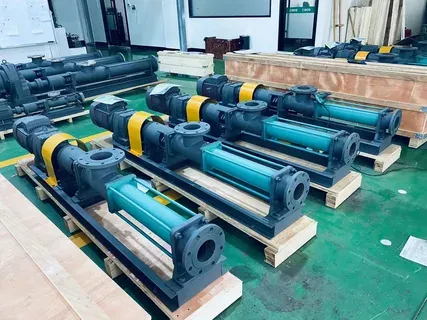
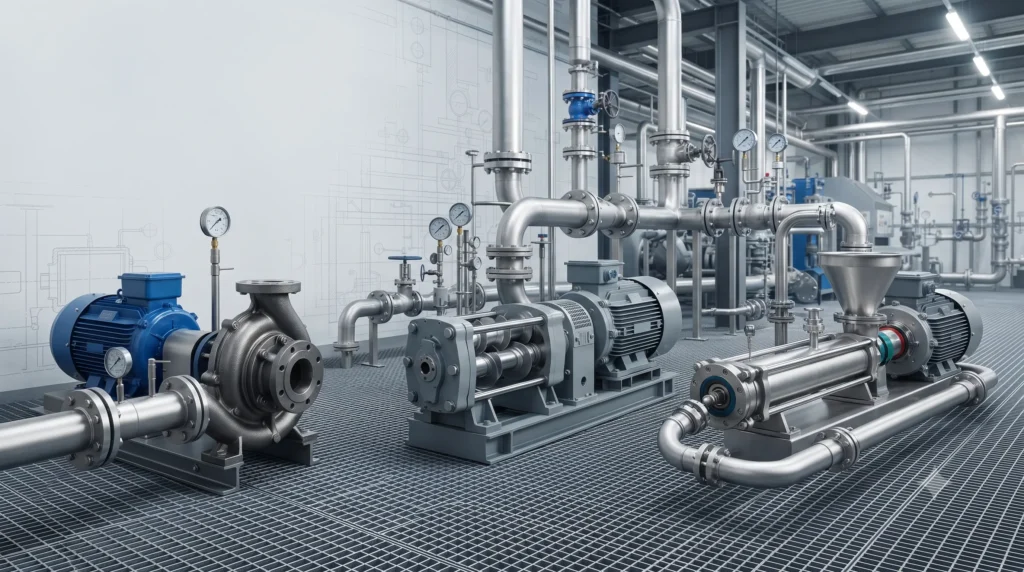
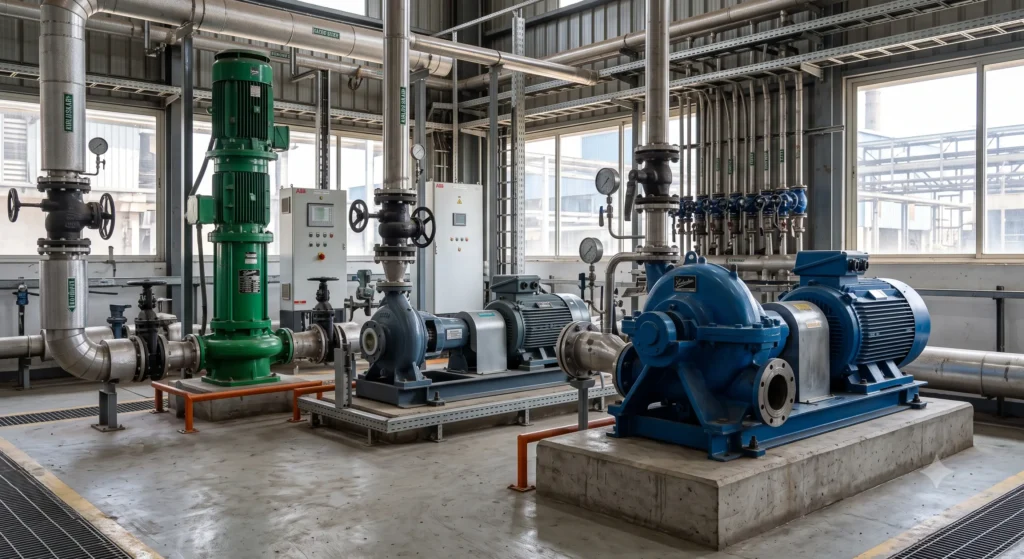
Industrial processes often involve transferring fluids that are thick, abrasive, sensitive, or highly viscous. In such demanding applications, screw pumps are among the most reliable positive displacement pumps available. They deliver a smooth, continuous, and pulse-free flow, making them an excellent choice for industries where precision and reliability are essential.
However, even the most robust screw pump requires regular maintenance and timely replacement of worn components to ensure optimum performance. This is where understanding Screw Pump Parts becomes crucial.
Every component inside a screw pump—from the rotor and shaft to bearings and mechanical seals—plays a vital role in maintaining flow efficiency, reducing downtime, and extending equipment life. Selecting the right replacement parts not only improves operational reliability but also helps lower maintenance costs and prevent unexpected breakdowns.
In this comprehensive guide, we’ll explore the different Screw Pump Parts, their functions, materials, industrial applications, and maintenance best practices. Whether you’re a maintenance engineer, plant manager, procurement professional, or business owner, this article will help you make informed decisions when maintaining or replacing screw pump components.
At Vartak Pumps and Project Consultants, we specialize in providing reliable industrial pumping solutions and technical expertise to help industries achieve maximum equipment performance and long-term operational efficiency.
What Are Screw Pump Parts?
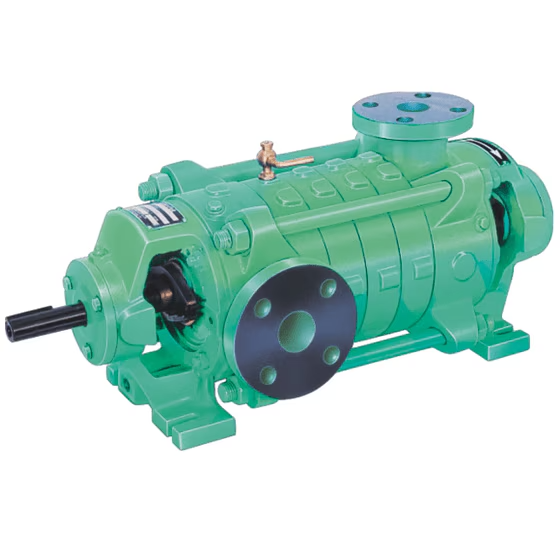
Screw Pump Parts are the individual components that work together to enable a screw pump to transfer liquids efficiently and reliably. Each part performs a specific function, such as moving the fluid, transmitting power, preventing leakage, or supporting rotating elements.
Over time, continuous operation, abrasive fluids, high temperatures, and demanding working conditions can cause these components to wear. Regular inspection and timely replacement of critical parts help maintain the pump’s efficiency, minimize unplanned downtime, and extend its service life.
Unlike centrifugal pumps, screw pumps rely on closely machined internal clearances between rotating screws and the pump casing. Because of this precision, using the correct replacement parts is essential to maintain volumetric efficiency and prevent performance loss.
Why Are High-Quality Screw Pump Parts Important?
Many industries focus on replacing damaged components only after a failure occurs. While this approach may seem cost-effective initially, it often results in expensive repairs, production losses, and reduced equipment life.
Investing in high-quality screw pump parts offers several long-term benefits:
- Improved pumping efficiency
- Reduced energy consumption
- Lower maintenance costs
- Extended equipment lifespan
- Reliable and continuous operation
- Reduced leakage
- Better pressure performance
- Less vibration and noise
- Higher plant productivity
- Reduced operational downtime
Using components that meet OEM specifications also ensures proper fit, reliable performance, and compatibility with your existing equipment.
Main Screw Pump Parts and Their Functions
Understanding each component helps in selecting the correct replacement part and identifying maintenance requirements before major failures occur.
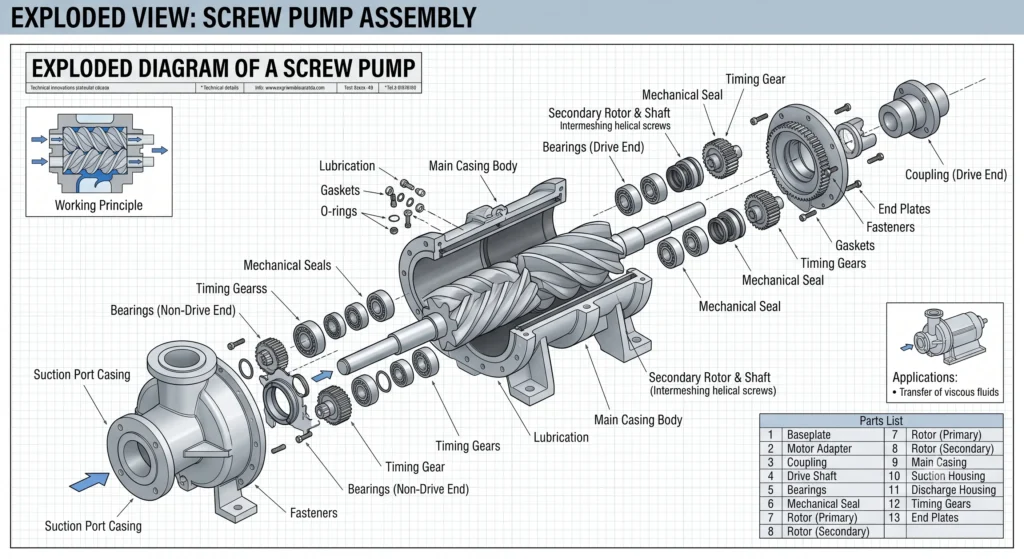
1. Screw Rotor (The Heart of the Pump)
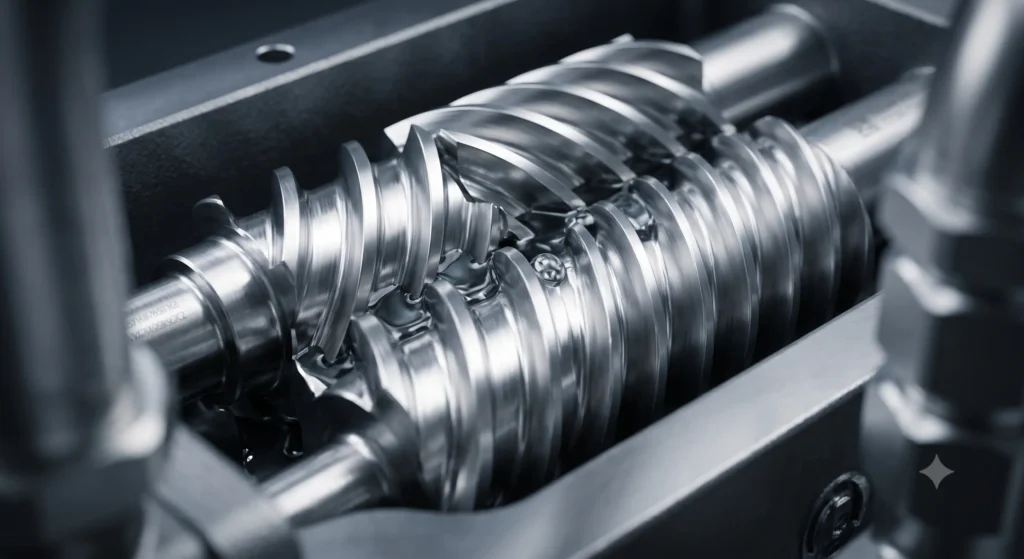
The screw rotor is the most important component of a screw pump. It is responsible for moving the liquid through the pump by creating sealed cavities that transport fluid smoothly from the suction side to the discharge side.
Unlike impellers used in centrifugal pumps, screw rotors provide a continuous flow with minimal pulsation, making them suitable for handling viscous liquids and shear-sensitive products.
Key Functions
- Transfers liquid efficiently
- Maintains constant flow rate
- Builds pressure gradually
- Reduces fluid pulsation
- Handles high-viscosity fluids
- Minimizes product damage
Common Materialst
- Stainless Steel
- Hardened Alloy Steel
- Duplex Stainless Steel
- Tool Steel
- Chrome-Plated Steel (for wear resistance)
Common Signs of Rotor Wear
- Reduced discharge pressure
- Lower flow rate
- Excessive internal leakage
- Increased power consumption
- Scoring or erosion on rotor surfaces
Regular inspection of the rotor is essential, especially in applications involving abrasive or contaminated fluids.
2. Drive Shaft
The drive shaft connects the motor to the screw rotor and transmits rotational power throughout the pump assembly. It is designed to withstand continuous torque while maintaining accurate alignment.
A damaged or bent shaft can lead to excessive vibration, premature bearing failure, and reduced pump efficiency.
Functions
- Transfers power from the motor
- Supports rotating components
- Maintains rotor alignment
- Ensures smooth operation
Typical Materials
- Carbon Steel
- Stainless Steel
- Alloy Steel
Common Problems
- Shaft bending
- Corrosion
- Wear on bearing journals
- Misalignment
- Fatigue cracks
Proper shaft alignment during installation significantly increases the life of the pump.
3. Mechanical Seal
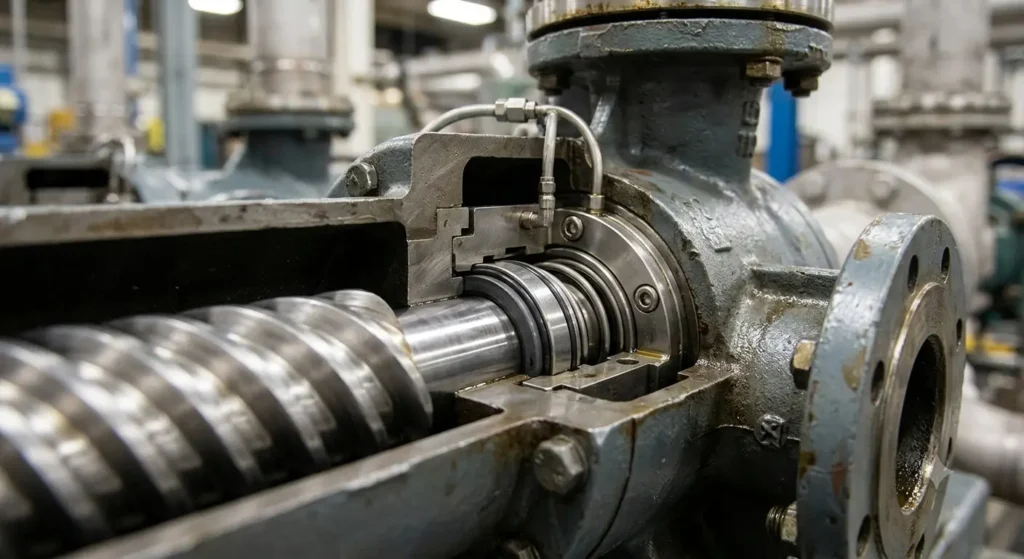
The mechanical seal prevents process fluid from leaking where the rotating shaft passes through the pump housing. It is one of the most frequently replaced screw pump parts due to continuous friction and exposure to varying operating conditions.
Modern mechanical seals are designed to reduce leakage, improve safety, and minimize maintenance compared to traditional gland packing systems.
Benefits of Mechanical Seals
- Prevents fluid leakage
- Improves workplace safety
- Reduces product loss
- Handles higher operating pressures
- Requires less maintenance
- Enhances pump reliability
Common Seal Materials
- Silicon Carbide
- Tungsten Carbide
- Carbon Graphite
- Ceramic
- PTFE
- Viton
- EPDM
Signs of Seal Failure
- Fluid leakage around the shaft
- Excessive heat generation
- Visible wear on seal faces
- Unusual noise
- Reduced pressure
Timely replacement of mechanical seals helps prevent major pump damage and costly production interruptions.
4. Bearings
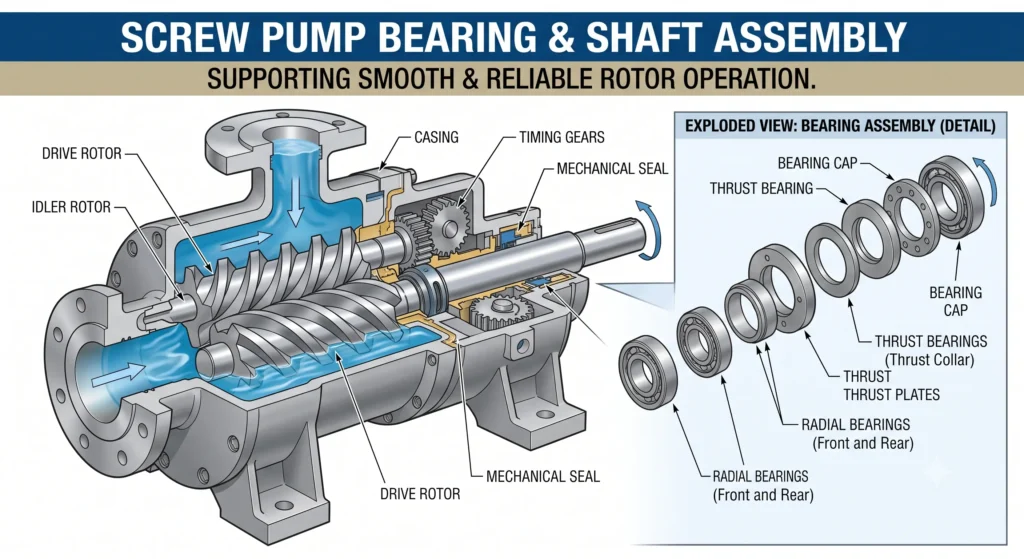
Bearings support the rotating shaft while reducing friction between moving components. They ensure smooth operation and help maintain proper alignment of the rotor assembly.
Well-maintained bearings improve efficiency and reduce vibration levels.
Types of Bearings
- Deep Groove Ball Bearings
- Angular Contact Bearings
- Roller Bearings
- Thrust Bearings
Common Bearing Failures
- Insufficient lubrication
- Contamination
- Misalignment
- Overloading
- Fatigue wear
Symptoms of Bearing Failure
- Increased vibration
- High operating temperature
- Unusual noise
- Reduced pump efficiency
- Shaft instability
Routine bearing inspections can prevent catastrophic failures and extend equipment life.
5. Bushes (Sleeve Bushings)
Bushes, also known as sleeve bushings, support rotating components while minimizing friction and maintaining alignment. They also protect the shaft from direct contact with surrounding components.
Functions
- Supports shaft movement
- Maintains alignment
- Reduces wear
- Absorbs vibration
- Protects rotating assemblies
Materials
- Bronze
- Stainless Steel
- PTFE Composite
- Graphite-Impregnated Materials
Bush wear should be monitored regularly, especially in high-load or abrasive applications.
6. Shaft Sleeve
The shaft sleeve acts as a protective barrier between the shaft and mechanical seal. Instead of replacing an expensive shaft due to wear, only the sleeve can be replaced, significantly reducing maintenance costs.
Benefits
- Protects the shaft
- Improves seal life
- Simplifies maintenance
- Reduces replacement costs
- Resists corrosion and abrasion
Common Materials
- Stainless Steel
- Hardened Steel
- Duplex Stainless Steel
- Ceramic-Coated Steel
7. Pump Casing
The pump casing forms the outer body of the screw pump and houses all the internal components. It is designed to withstand operating pressure while providing a leak-proof path for fluid movement.
Functions
- Supports internal components
- Withstands operating pressure
- Directs fluid flow
- Protects rotating assemblies
- Maintains pump rigidity
Common Materials
- Cast Iron
- Carbon Steel
- Stainless Steel (SS304, SS316)
- Duplex Stainless Steel
- Alloy Steel
8. O-Rings
O-rings are small but critical sealing elements used throughout the pump assembly to prevent leakage between mating surfaces.
Advantages
- Excellent sealing performance
- Easy installation
- Cost-effective replacement
- Resistant to pressure variations
Common Materials
- NBR (Nitrile)
- Viton (FKM)
- EPDM
- PTFE
- Silicone
Always select O-ring material based on fluid compatibility and operating temperature.
9. Gaskets
Gaskets seal stationary joints within the pump and prevent leakage from casing connections.
Types
- Rubber Gaskets
- PTFE Gaskets
- Graphite Gaskets
- Spiral Wound Gaskets
10. Coupling
The coupling connects the electric motor to the pump shaft and transmits torque while compensating for slight misalignment.
Types
- Flexible Coupling
- Gear Coupling
- Jaw Coupling
- Pin Bush Coupling
Proper alignment significantly increases bearing and seal life.
11. Bearing Housing
The bearing housing protects the bearings against contamination while ensuring proper lubrication.
Benefits
- Supports bearings
- Protects against dust and moisture
- Extends bearing life
- Improves pump reliability
12. Wear Plates
Wear plates protect internal surfaces from abrasive fluids and reduce damage to the pump casing.
They are commonly used in heavy-duty industrial applications involving slurries or contaminated liquids.
13. Fasteners
Industrial-grade fasteners secure all pump components together.
These include:
- Bolts
- Nuts
- Washers
- Lock Nuts
- Studs
Although often overlooked, using the correct fasteners with the proper torque is essential for safe and reliable operation.
Complete Screw Pump Parts List
| Component | Primary Function |
|---|---|
| Screw Rotor | Moves fluid through the pump |
| Drive Shaft | Transfers motor power |
| Mechanical Seal | Prevents leakage |
| Bearings | Support rotating shaft |
| Bushes | Maintain alignment |
| Shaft Sleeve | Protects shaft from wear |
| Pump Casing | Houses internal components |
| O-Rings | Static sealing |
| Gaskets | Leak-proof joints |
| Coupling | Connects motor and pump |
| Bearing Housing | Supports bearings |
| Wear Plates | Protect against abrasion |
| Fasteners | Secure assembly |
How Does a Screw Pump Work?
Understanding the working principle helps users appreciate why each component is so important.
Step 1 – Fluid Enters Through the Suction Port
The liquid enters the pump through the inlet.
Step 2 – Rotating Screws Trap the Fluid
One or more precision-machined screws rotate inside the casing, creating sealed cavities between the screw threads and housing.
Step 3 – Fluid Moves Smoothly
As the screws rotate, the trapped liquid is transported continuously along the length of the pump without significant turbulence or pulsation.
Step 4 – Fluid Exits Under Pressure
The fluid reaches the discharge port with a steady flow and controlled pressure, making screw pumps ideal for handling viscous or shear-sensitive liquids.
For additional technical guidance on pump design, operation, and industry practices, readers can refer to the Hydraulic Institute, an established source of pump industry standards and technical resources.
Why Are Screw Pumps Preferred?
Compared with many other pump types, screw pumps offer:
- Pulse-free flow
- Low noise levels
- High efficiency
- Excellent suction capability
- Smooth handling of delicate products
- Ability to pump high-viscosity liquids
- Reliable continuous-duty operation
Materials Used in Screw Pump Parts
Material selection directly affects performance, durability, and corrosion resistance.
| Part | Common Materials |
|---|---|
| Rotor | Stainless Steel, Alloy Steel |
| Shaft | Carbon Steel, Stainless Steel |
| Casing | Cast Iron, Carbon Steel, Stainless Steel |
| Bearings | Chrome Steel |
| Bushes | Bronze, PTFE |
| Mechanical Seal | Silicon Carbide, Carbon, Tungsten Carbide |
| O-Rings | NBR, Viton, EPDM |
| Gaskets | PTFE, Graphite |
Selecting the appropriate material depends on the fluid type, operating temperature, pressure, and chemical compatibility.
Industrial Applications of Screw Pump Parts
Because screw pumps are used across a wide range of industries, demand for reliable replacement parts remains high.
Oil & Gas Industry
Screw pumps handle:
- Crude oil
- Diesel
- Lubricating oil
- Fuel oil
- Bitumen
Common replacement parts include:
- Mechanical seals
- Bearings
- Rotors
- Shaft sleeves
Chemical Industry
Suitable for transferring:
- Acids
- Solvents
- Polymers
- Resins
- Corrosive chemicals
Materials such as stainless steel, PTFE, and Viton are commonly specified for compatibility.
Food & Beverage Industry
Screw pumps are ideal for products that require gentle handling.
Applications include:
- Chocolate
- Syrups
- Honey
- Molasses
- Dairy products
- Fruit concentrates
Food-grade materials and hygienic seals are essential in these environments.
Pharmaceutical Industry
High-precision screw pumps are used for:
- Process liquids
- High-purity fluids
- Sensitive formulations
They often require sanitary designs and FDA-compliant materials.
Marine Industry
Typical applications include:
- Fuel transfer
- Lubrication systems
- Bilge pumping
- Hydraulic oil transfer
Wastewater Treatment
Screw pumps efficiently handle:
- Sludge
- Waste oil
- Thick liquids
- Industrial wastewater
Common Problems Caused by Worn Screw Pump Parts
Even a well-maintained pump will eventually experience component wear. Recognizing early warning signs can help avoid major failures.
| Problem | Possible Cause |
|---|---|
| Low Flow Rate | Rotor wear or internal leakage |
| Pressure Drop | Worn screw or damaged seals |
| Leakage | Mechanical seal failure |
| Excessive Vibration | Bearing wear or shaft misalignment |
| Overheating | Poor lubrication or worn bearings |
| High Noise | Damaged bearings or coupling issues |
| Increased Power Consumption | Internal wear or excessive friction |
Ignoring these symptoms can lead to reduced efficiency, higher operating costs, and unexpected downtime.
Preventive Maintenance Tips
Regular maintenance extends pump life and minimizes costly repairs.
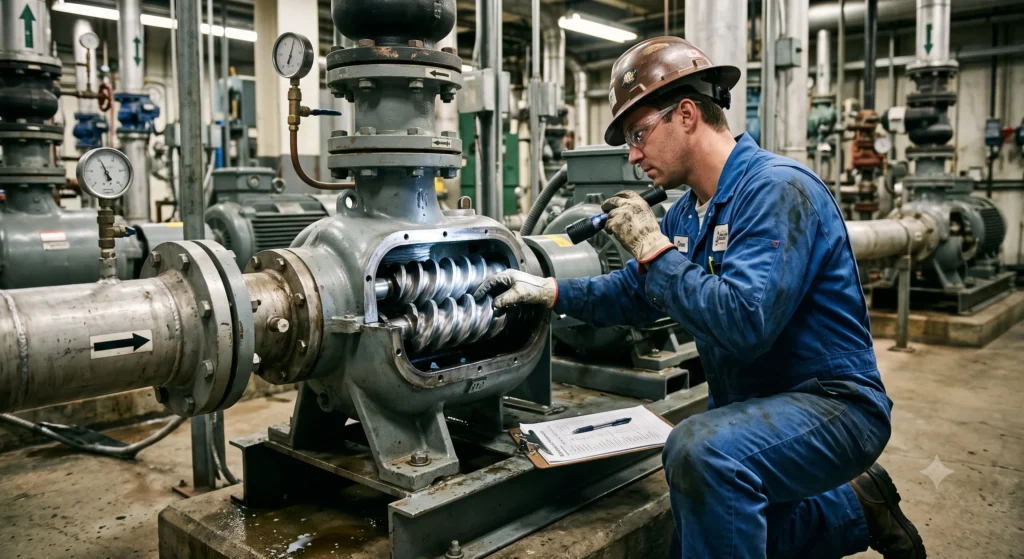
Recommended Practices
- Inspect bearings at scheduled intervals.
- Check mechanical seals for leakage.
- Monitor vibration and temperature.
- Lubricate bearings according to manufacturer recommendations.
- Verify shaft alignment after maintenance.
- Replace worn O-rings and gaskets promptly.
- Clean suction strainers regularly.
- Avoid dry running.
- Use compatible lubricants.
- Keep maintenance records for trend analysis.
For industrial organisations, maintenance activities can also form part of a broader quality and asset-management system. Relevant ISO standards can provide a framework for establishing consistent processes and continual improvement.
A proactive maintenance approach reduces the likelihood of sudden equipment failure.
How to Choose the Right Screw Pump Parts
Selecting the correct replacement parts is essential for maintaining pump performance and reliability.
Identify the Pump Model
Always record the:
- Manufacturer
- Model number
- Serial number
- Year of manufacture
This information ensures compatibility.
Understand Operating Conditions
Consider:
- Flow rate
- Pressure
- Temperature
- Fluid viscosity
- Chemical composition
- Presence of abrasive particles
These factors influence material selection and part design.
Choose the Right Materials
Corrosive or high-temperature applications may require stainless steel, duplex stainless steel, or specialized elastomers such as Viton or PTFE.
Verify OEM Specifications
Replacement components should match the original dimensions and performance requirements to maintain efficiency and reliability.
Buy from a Trusted Supplier
Working with a knowledgeable supplier ensures access to quality components, technical support, and proper guidance when selecting replacement parts.
For industrial equipment, design and material requirements may also need to comply with applicable engineering codes and standards. ASME provides widely recognised engineering standards used across pressure equipment and mechanical engineering applications.
Why Proper Spare Part Selection Matters
Using incorrect or poor-quality parts can result in:
- Reduced pump efficiency
- Increased energy consumption
- Premature equipment failure
- More frequent maintenance
- Higher operating costs
- Unexpected production downtime
Choosing quality replacement parts and following recommended maintenance practices helps maximize the service life of your screw pump and ensures dependable performance in demanding industrial applications.
Screw Pump vs Centrifugal Pump
One of the most common questions engineers and buyers ask is whether they should choose a Screw Pump or a Centrifugal Pump. While both are widely used in industrial applications, they operate on different principles and are suited for different types of fluids.
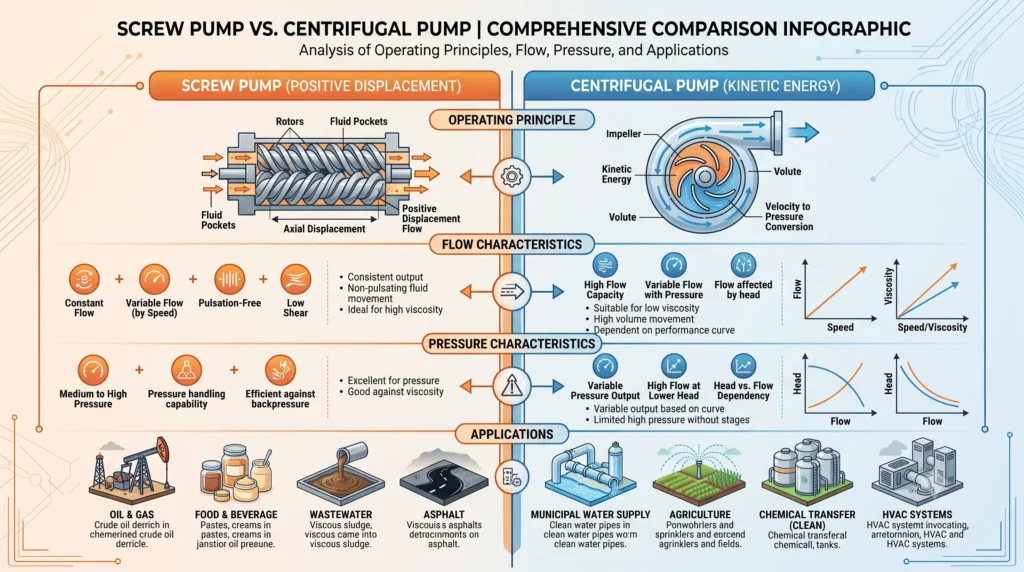
| Feature | Screw Pump | Centrifugal Pump |
|---|---|---|
| Pump Type | Positive Displacement | Dynamic Pump |
| Flow | Constant & Pulse-Free | Depends on Pressure |
| Best For | High-Viscosity Fluids | Low-Viscosity Fluids |
| Self-Priming | Yes (Most Models) | Usually No |
| Shear Sensitive Liquids | Excellent | Moderate |
| High Pressure | Excellent | Moderate |
| Dry Running | Not Recommended | Not Recommended |
| Maintenance | Moderate | Low to Moderate |
| Typical Industries | Oil, Chemical, Food | Water, HVAC, Utilities |
When Should You Choose a Screw Pump?
A screw pump is the preferred choice when handling:
- High-viscosity liquids
- Lubricating oils
- Fuel oils
- Syrups
- Molasses
- Sludge
- Bitumen
- Polymer solutions
- Shear-sensitive products
Screw Pump vs Gear Pump
Both pumps are positive displacement pumps, but they differ significantly in design and performance.
| Feature | Screw Pump | Gear Pump |
|---|---|---|
| Flow Quality | Very Smooth | Slight Pulsation |
| Noise Level | Low | Moderate |
| Viscous Liquids | Excellent | Very Good |
| Pressure Capability | High | Medium |
| Wear Resistance | Better for Continuous Duty | Good |
| Product Handling | Gentle | Moderate |
Common Screw Pump Problems & Troubleshooting
Even well-maintained screw pumps may encounter operational issues over time. Early diagnosis helps reduce downtime and repair costs.
| Problem | Possible Cause | Recommended Solution |
|---|---|---|
| Low Flow Rate | Rotor Wear | Inspect and replace rotor if necessary |
| Reduced Pressure | Internal Leakage | Check clearances and seals |
| Pump Leakage | Worn Mechanical Seal | Replace seal assembly |
| Excessive Noise | Bearing Damage | Replace bearings and inspect lubrication |
| High Vibration | Shaft Misalignment | Realign motor and pump |
| Pump Overheating | Poor Lubrication | Verify lubrication schedule |
| High Power Consumption | Internal Friction | Inspect bearings and rotating components |
| Motor Overload | Blocked Discharge | Inspect discharge line |
| Cavitation | Poor Suction Conditions | Improve suction piping |
| Frequent Seal Failure | Dry Running | Ensure adequate liquid supply before operation |
Preventive Maintenance Checklist
A preventive maintenance program can significantly increase the service life of your screw pump.
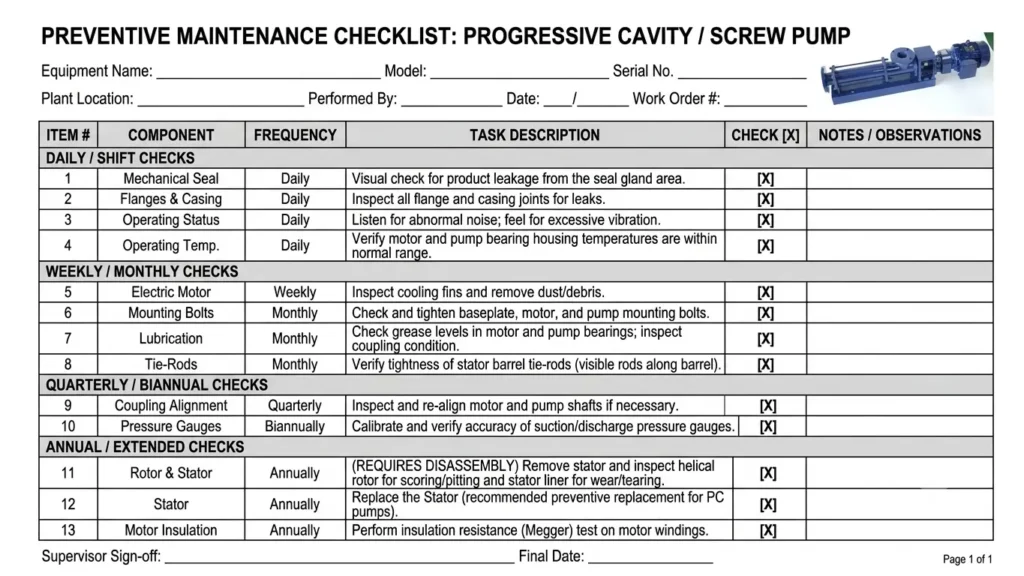
Daily
- Check for unusual noise.
- Inspect for visible leakage.
- Monitor pressure and flow.
- Observe vibration levels.
Weekly
- Check coupling alignment.
- Inspect mechanical seals.
- Verify lubrication levels.
- Clean surrounding equipment.
Monthly
- Inspect bearings.
- Check fasteners.
- Inspect shaft sleeve.
- Verify operating temperature.
Quarterly
- Inspect rotor wear.
- Replace worn O-rings.
- Inspect pump casing.
- Check motor performance.
Annually
- Complete pump overhaul (if required).
- Replace worn bearings.
- Replace seals.
- Inspect internal clearances.
- Perform performance testing.
Following a planned maintenance schedule minimizes unexpected failures and helps maintain optimum pump performance.
Benefits of Using Genuine Screw Pump Parts
Using high-quality or OEM-equivalent screw pump parts offers several long-term advantages.
Improved Performance
Precision-manufactured parts maintain the pump’s original operating efficiency.
Longer Equipment Life
Quality materials reduce wear on rotating components.
Lower Maintenance Costs
Reliable components reduce the frequency of breakdowns.
Increased Safety
Proper sealing minimizes the risk of leakage, protecting personnel and the environment.
Reduced Downtime
Correctly fitted replacement parts help avoid repeated maintenance interruptions.
Better Energy Efficiency
Well-maintained pumps consume less power and operate more efficiently.
Why Choose Vartak Pumps and Project Consultants?
At Vartak Pumps and Project Consultants, we understand that every industrial application has unique requirements. Whether you need assistance with selecting the right pump, identifying replacement components, or improving system performance, our experienced team is here to help.
Our expertise covers a wide range of industrial pumping solutions across sectors such as oil & gas, chemicals, food processing, pharmaceuticals, water treatment, power generation, and manufacturing.
Our Services Include
- Industrial pump selection assistance
- Technical consultation
- Screw pump parts identification
- Spare parts support
- Pump maintenance guidance
- System performance optimization
- After-sales technical assistance
Our goal is to help customers improve operational reliability, reduce downtime, and maximize the return on their pumping equipment investment.
Frequently Asked Questions (FAQs)
1. What are Screw Pump Parts?
Screw Pump Parts are the individual components that make up a screw pump, including the rotor, shaft, bearings, seals, casing, O-rings, and couplings. These components work together to transfer fluids efficiently.
2. Which Screw Pump Part wears out most frequently?
Mechanical seals, bearings, O-rings, and gaskets are among the components that typically require replacement due to continuous operation and normal wear.
3. How often should Screw Pump Parts be replaced?
Replacement intervals depend on operating conditions, fluid type, maintenance practices, and equipment usage. Regular inspections are recommended to identify wear before failures occur.
4. Can Screw Pump Parts be repaired instead of replaced?
Some components, such as shafts or casings, may be repairable depending on the extent of damage. However, seals, bearings, and O-rings are generally replaced rather than repaired.
5. Which industries commonly use Screw Pumps?
Screw pumps are widely used in oil & gas, chemical processing, food and beverage, pharmaceuticals, marine, wastewater treatment, and manufacturing industries.
6. What causes Screw Pump failure?
Common causes include dry running, inadequate lubrication, abrasive fluids, shaft misalignment, cavitation, contamination, and delayed maintenance.
7. How can I extend the life of my Screw Pump?
Regular maintenance, proper lubrication, correct alignment, timely replacement of worn components, and using suitable materials for the pumped fluid can significantly extend pump life.
9. Can Screw Pumps handle abrasive fluids?
Yes, certain screw pumps are designed for abrasive fluids, but appropriate materials and wear-resistant components should be selected for the application.
10. How do I identify the correct replacement part?
Record the pump manufacturer, model number, serial number, operating conditions, and material requirements before ordering replacement parts.
Final Thoughts
Screw pumps are trusted across numerous industries because they provide reliable, smooth, and efficient fluid handling. However, the performance of any screw pump depends on the condition of its individual components.
Understanding the function of each Screw Pump Part – from rotors and shafts to bearings, seals, and couplings – enables operators to implement proactive maintenance strategies, reduce downtime, and improve overall equipment reliability.
Whether you’re planning preventive maintenance, replacing worn components, or upgrading an existing system, selecting the right parts and following recommended maintenance practices will help maximize the lifespan and efficiency of your screw pump.
Get Expert Support from Vartak Pumps and Project Consultants
Choosing the right screw pump parts can improve system performance, reduce maintenance costs, and enhance operational reliability. At Vartak Pumps and Project Consultants, we provide expert guidance to help industries identify suitable pumping solutions and replacement components based on their specific operating requirements.
If you need technical assistance with Screw Pump Parts, our team is ready to help you make informed decisions that support long-term performance and productivity.