 WILO Mather Platt: No.1 channel partner in India consecutively from year 2015-2025
Oil Lubricated vs Oil-Free Rotary Screw Air Compressors
When compressed air is a critical part of production, the compressor is much more than another utility machine sitting in the plant room. It is effectively the heart of the compressed-air system. Pneumatic tools, automation systems, valves, instrumentation, packaging equipment and production machinery may all depend on a reliable supply of compressed air. But here is the question many businesses eventually face: Should you choose an oil lubricated rotary screw air compressor or an oil-free rotary screw air compressor?
The answer depends heavily on the application. An oil lubricated rotary screw air compressors uses oil inside the compression process for several important functions, including cooling, sealing and lubrication. Downstream separation and filtration are then used to control oil carryover in the compressed air. CompAir explains that oil-injected rotary screw compressors use oil in the compression chamber for cooling, lubrication, sealing and noise reduction, with an oil separator removing most of the oil before the air leaves the package. An oil-free rotary screw air compressor, by comparison, does not use oil in the compression cavities and is designed for applications where compressed-air purity is critical.
This distinction is especially important in industries such as pharmaceuticals, food and beverage, electronics and certain chemical processes. CompAir’s current oil-free portfolio includes Class 0 certified rotary screw technologies designed for applications requiring highly pure compressed air. For businesses evaluating oil lubricated screw air compressors, oil lubricated rotary screw air compressors, oil free screw compressors, screw air compressor oil and Gardner Denver CompAir compressor solutions, the right decision should be based on air quality, pressure, flow, operating profile, lifecycle cost and process requirements rather than purchase price alone.
What Is a Rotary Screw Air Compressor?
A rotary screw air compressor is a positive-displacement compressor that uses rotating screw elements to compress air continuously. Unlike a reciprocating compressor, which uses pistons moving back and forth, a rotary screw compressor draws air into the compression element and progressively reduces its volume as the rotors rotate. This produces a continuous flow of compressed air, making rotary screw technology particularly suitable for industrial applications with steady or variable compressed-air demand.
The basic principle sounds simple, but modern screw compressors are highly engineered machines. The airend, motor, cooling system, control system, separator system, filters and other components must work together to deliver the required pressure and flow efficiently. CompAir describes the screw compressor as one of the most widely used types of lubricated compressors and identifies it as a predominant positive-displacement technology for industrial compressed-air generation.
How a Rotary Screw Compressor Works
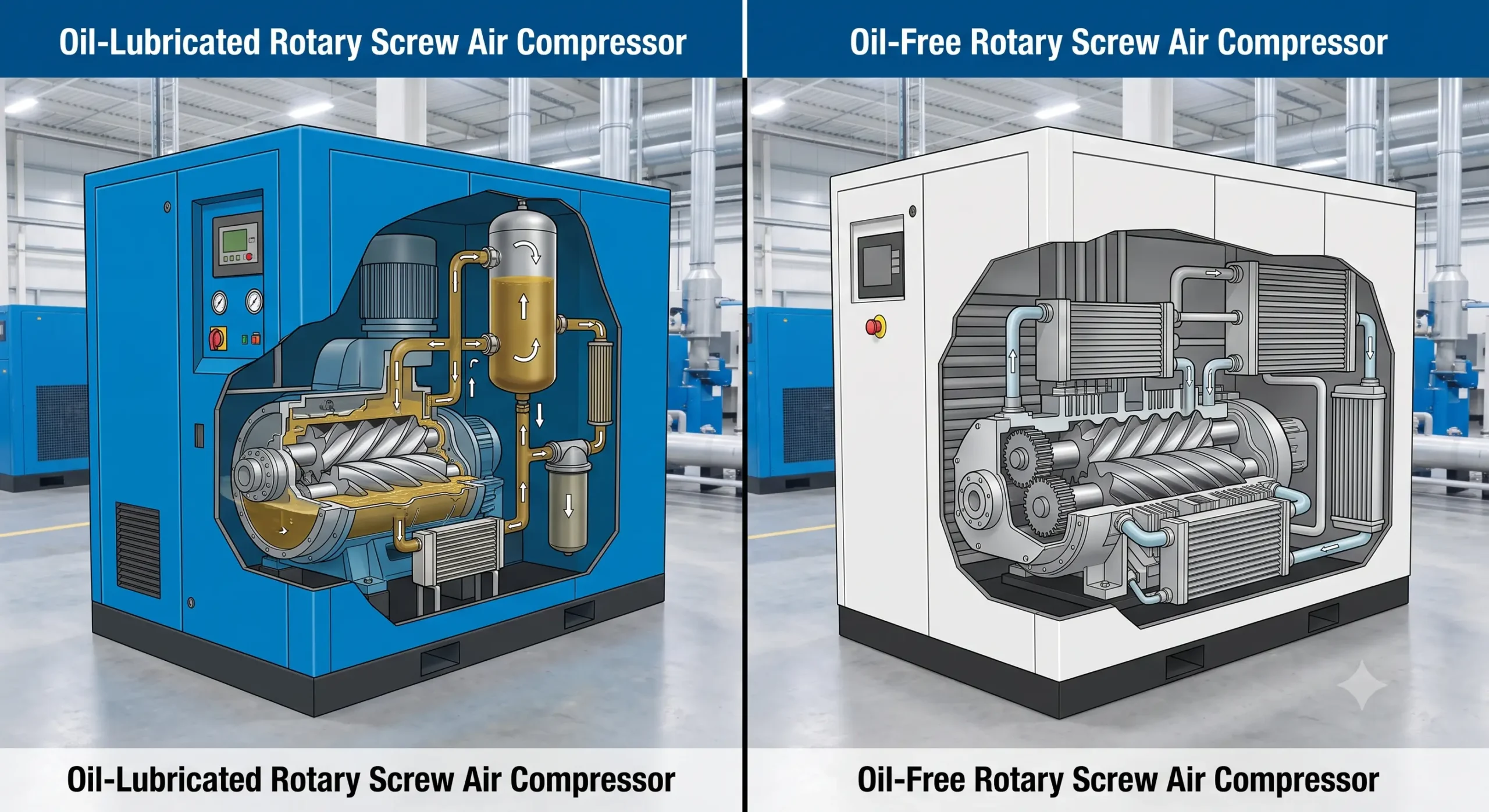
Air enters through the compressor inlet and passes into the screw airend. Inside the airend, two intermeshing rotors rotate and progressively compress the trapped air. In an oil lubricated rotary screw air compressor, oil is injected into the compression chamber during this process. The oil helps cool the compressed air and compression element, lubricates moving components, creates sealing between the rotating elements and contributes to noise reduction.
After compression, the air-oil mixture enters a separation system. The separator removes the majority of the oil before compressed air proceeds toward the aftercooler and downstream treatment equipment. CompAir states that coalescent filtration can further reduce oil content after the primary separation stage.
In an oil-free compressor, the compression chamber does not use oil. Depending on the technology, cooling and sealing can be achieved through other design approaches. CompAir’s DH series, for example, uses high-quality water for lubrication, cooling and sealing, while its oil-free two-stage technologies use specially engineered compression elements.
What Is an Oil Lubricated Rotary Screw Air Compressor?
An oil lubricated rotary screw air compressor is a screw compressor in which oil is introduced into the compression process. The term “oil lubricated” describes the role of oil within the compressor rather than suggesting that the final compressed air should contain large quantities of oil. In a properly designed and maintained system, most of the oil is separated from the compressed air before it reaches the outlet.
Oil has several jobs inside the compressor. It provides lubrication to moving parts, helps seal the compression chamber, removes heat generated during compression and can reduce operating noise. This multifunctional role is one of the reasons oil-injected screw compressors are widely used across general industrial applications. CompAir specifically identifies cooling, lubrication, sealing and noise dissipation as the four main functions of oil in an injected screw compressor.
Modern oil lubricated rotary screw air compressors are available in fixed-speed and variable-speed configurations. Variable-speed models can adjust compressor output according to system demand, which can be particularly valuable in plants where compressed-air consumption changes throughout the production cycle. CompAir’s current lubricated range includes multiple power classes and both fixed- and regulated-speed options.
Role of Screw Air Compressor Oil
Screw air compressor oil is not simply ordinary industrial lubricating oil poured into the machine. The compressor requires oil with characteristics suited to its operating temperature, pressure, lubrication requirements and manufacturer specifications. Using an incorrect lubricant can affect viscosity, cooling performance, oxidation stability, separator performance and component life.
The oil also needs to work with the compressor’s separator and filtration system. CompAir recommends using the correct oil and notes that genuine OEM oil is the preferred choice for maintaining system integrity and performance.
Regular oil maintenance is therefore essential. Depending on the compressor model and operating conditions, maintenance may involve checking oil level, replacing oil and oil filters, inspecting separators and monitoring operating temperature. The correct service interval should always follow the compressor manufacturer’s maintenance instructions.
What Is an Oil-Free Rotary Screw Air Compressor?
An oil-free rotary screw air compressor is designed so that oil does not enter the compression chamber. This is fundamentally different from an oil-injected compressor. The purpose is to prevent oil contamination from entering the compressed-air stream at the source.
Why does that matter? Imagine a manufacturing process where even a small amount of oil contamination could affect the final product. In pharmaceutical production, food processing, electronics manufacturing or other sensitive applications, compressed air can become part of the production environment. In such cases, relying solely on downstream oil separation may not provide the level of air purity the process requires.
CompAir’s oil-free rotary screw compressor portfolio includes technologies certified to ISO 8573-1:2010 Class 0, with current ranges covering different power and flow requirements. The company specifically identifies food and beverage, pharmaceutical, textile and electronics applications for its Class 0 oil-free technologies.
Oil Lubricated vs Oil-Free Screw Compressors
The biggest difference between oil lubricated rotary screw air compressors and oil-free screw compressors is the role of oil in the compression process. In an oil-injected compressor, oil is deliberately introduced into the compression chamber and subsequently separated from the compressed air. In an oil-free design, oil is not used in the compression cavities.
That difference affects air purity, equipment design, maintenance requirements, purchase cost and application suitability. It does not automatically mean that an oil-free compressor is “better” for every plant. The right choice depends on what the compressed air is being used for.
| Factor | oil lubricated rotary screw air compressors | Oil-Free Rotary Screw |
|---|---|---|
| Oil in compression chamber | Yes | No |
| Air purity | Requires separation and downstream treatment | Designed for oil-free air |
| Typical applications | General industry, tools, automation, manufacturing | Food, pharma, electronics and critical processes |
| Initial investment | Generally lower | Generally higher |
| Lubricant maintenance | Required | No compression-chamber oil |
| Downstream filtration | Often required | Still depends on total air-quality requirement |
| Very high air purity | Application dependent | Strong choice |
| Variable-speed options | Available | Available on many models |
| Selection priority | Cost, reliability, air demand | Purity, process protection, efficiency |
These seven proven differences show why the choice between oil lubricated rotary screw air compressors and oil-free models must be driven by the application rather than price alone.
Air Quality and Contamination
Air quality should be the first question when comparing compressor technologies. If the compressed air is used only for general pneumatic tools, workshop equipment or industrial automation where oil contamination can be controlled through appropriate filtration, an oil lubricated compressor can be an effective solution.
If the air comes into direct contact with a product or a process that cannot tolerate oil contamination, an oil-free compressor may be the more appropriate technology. CompAir’s oil-free systems are designed specifically around applications where compressed-air purity is critical.
The important point is that “oil-free” and “clean air” are not interchangeable marketing phrases. Air quality should be specified using the appropriate standards and filtration requirements for the application. ISO 8573-1 classification is commonly used to define compressed-air purity requirements.
Energy Efficiency and Operating Cost
Energy is usually one of the biggest lifecycle costs of compressed air. The purchase price of a compressor may look significant, but electricity consumed during years of operation can have an even greater impact on total cost.
Variable-speed technology can help when demand fluctuates because the compressor can adjust output rather than repeatedly operating at full capacity. CompAir’s current lubricated and oil-free ranges include regulated-speed configurations.
This is why compressor selection should consider total cost of ownership, including electricity, maintenance, consumables, downtime and service requirements. A slightly higher initial investment can make commercial sense if it substantially reduces operating costs over the machine’s working life.
Oil Lubricated Screw Air Compressor Applications
Oil lubricated screw air compressors are widely used where compressed air is required for general industrial operations and the air-quality specification can be achieved through suitable downstream treatment. Manufacturing plants, workshops, engineering facilities, construction-related operations, general pneumatic systems and many process industries use lubricated compressors.
Typical applications include pneumatic tools, air-operated valves, general automation, material handling, cleaning, packaging machinery and production equipment. The important factor is not simply whether the industry “uses compressed air,” but whether the air comes into contact with the product or requires a particular purity classification.
For general-purpose applications, the combination of an oil-injected compressor with suitable air treatment can provide a practical balance between reliability, efficiency and capital cost. CompAir notes that lubricated compressors can be paired with downstream filters and dryers to achieve the required air quality for many industrial applications.
Oil-Free Screw Compressor Applications
Oil-free screw compressors become especially relevant when compressed-air contamination could affect the process, product or equipment. The food and beverage sector is a clear example because compressed air can be used during production, packaging or handling. Pharmaceutical manufacturing can have even stricter requirements because air purity may influence product quality and process compliance.
Other applications include electronics manufacturing, certain textile processes, laboratories and specialized chemical processes. CompAir’s current oil-free portfolio specifically identifies food and beverage, pharmaceutical, textile and electronics applications for its Class 0 systems.
The business case for oil-free technology is therefore often about risk reduction, not just energy efficiency. If contamination could cause product rejection, equipment damage, regulatory problems or production downtime, preventing contamination at the compression stage can be extremely valuable.
Types of Oil-Free Rotary Screw Compressors
Oil-free screw technology is not a single compressor design. Different manufacturers use different engineering approaches to achieve oil-free compression. Some systems use two-stage compression, while others use water injection or other specialized designs.
CompAir’s current portfolio includes two-stage oil-free rotary screw compressors and water-injected oil-free screw compressors. Its D-series, for example, covers oil-free two-stage technology, while the DH series uses water injection in a single-stage compression process.
CompAir’s current D37-D75 range is offered from 37 to 75 kW with fixed- and regulated-speed versions, while the company states that the wider D-series range extends into larger capacities. (CompAir) Its DS range covers 37–150 kW, with published capacity up to 25.9 m³/min at 7 bar(g).
The technology should therefore be selected according to required pressure, flow, operating profile and air-quality specification rather than by searching for the words “oil-free” alone.
Fixed-Speed vs Variable-Speed Screw Compressors
A fixed-speed screw compressor generally operates around a predetermined motor speed, while a variable-speed or regulated-speed compressor can adjust its output to match changing air demand. This distinction can have a major effect on energy consumption when plant demand is variable.
Consider a factory where compressed-air consumption is high during production but falls significantly during breaks, shift changes or weekends. A fixed-speed compressor may have to unload or cycle during lower-demand periods. A regulated-speed compressor can adjust its operating point to better follow demand.
CompAir currently offers both fixed- and regulated-speed configurations across parts of its lubricated and oil-free ranges. The correct choice should be based on an actual demand profile rather than assuming that variable speed is automatically the best solution for every installation.
Important Oil Lubricated Compressor Components
A typical oil lubricated rotary screw compressor contains several systems that work together. The airend performs the compression, while the motor provides rotational power. The oil circuit manages lubrication and cooling, and the separator system removes oil from the compressed air after compression.
Important components include the compressor airend, electric motor, oil separator, oil filter, air filter, oil cooler, aftercooler, thermostatic valve, inlet valve, control system and pressure sensors. Depending on the compressor design, additional components may include variable-frequency drives, condensate management systems and heat-recovery equipment.
The separator is particularly important because it reduces oil carryover into the compressed-air system. If the separator becomes damaged, blocked or incorrectly maintained, pressure drop and oil carryover can increase. This is why preventive maintenance should never focus only on the compressor oil itself.
Screw Air Compressor Oil: Types, Functions & Maintenance
Choosing the correct screw air compressor oil is one of the most important maintenance decisions for an oil-injected compressor. The lubricant must maintain its performance under the compressor’s operating temperature and pressure while providing effective lubrication and heat transfer.
Different compressor manufacturers and models may require different lubricant specifications. Therefore, simply choosing an oil because its viscosity looks similar is not a safe approach. The compressor manufacturer’s approved lubricant specification should be followed.
Oil condition can also provide useful information about compressor health. Changes in colour, viscosity, contamination or oil consumption can indicate issues that require investigation. Regular oil and filter changes help maintain cooling and lubrication performance, but service intervals should always be based on the manufacturer’s recommendations and actual operating conditions.
How to Select the Right Rotary Screw Air Compressor
Selecting between an oil lubricated rotary screw air compressor and an oil-free rotary screw air compressor should begin with the application. Start by asking what the compressed air actually does. Does it contact the product? Is contamination unacceptable? What pressure does the equipment require? How much air is required during peak and average production?
A useful compressor selection process should consider:
- Required air flow
- Operating pressure
- Peak and average demand
- Required air-quality class
- Oil contamination tolerance
- Compressor room temperature
- Cooling method
- Operating hours
- Fixed or variable demand
- Available electrical supply
- Installation space
- Maintenance capability
- Future expansion
- Total cost of ownership
Once these are known, you can decide whether oil lubricated rotary screw air compressors or oil-free technology is the better fit.
Compressor Capacity, Pressure and Air Demand
Compressor capacity should be matched to actual system demand, not simply the maximum theoretical consumption of every connected machine. Oversizing can increase capital expenditure and lead to inefficient operation, while undersizing can cause pressure instability and production problems.
Pressure also matters. A compressor designed for a particular pressure range may deliver a different flow at another operating pressure. The compressor should therefore be evaluated using its published performance data at the actual operating point.
Demand profiling can be especially useful in larger facilities. Understanding minimum, average and peak air consumption can help determine whether one large compressor, multiple compressors or a combination of fixed- and variable-speed machines provides the best solution.
Maintenance Requirements for Rotary Screw Compressors
A reliable oil lubricated rotary screw air compressors depends on preventive maintenance. Air filters, oil filters, separators, lubricants, coolers and control systems all require periodic inspection or replacement. Keeping the compressor room clean and maintaining suitable ventilation can also influence performance.
Oil-free compressors have their own maintenance requirements even though they do not use oil in the compression chamber. Their airends, bearings, seals, cooling systems, valves and control equipment still need scheduled service. Oil-free should therefore never be interpreted as “maintenance-free.”
CompAir provides service and parts support programs built around preventive maintenance, genuine parts and trained technicians.
Common Problems With Screw Air Compressors
Common compressor problems include excessive temperature, low pressure, high oil carryover, abnormal noise, high energy consumption, frequent loading and unloading, filter blockage and unexpected shutdowns. In oil-injected machines, incorrect lubricant, degraded oil, separator problems or inadequate cooling can contribute to performance issues.
In oil-free compressors, issues may involve compression-element performance, seals, cooling systems, bearings, controls or other specialized components. The troubleshooting approach therefore depends heavily on compressor technology and model.
One of the best ways to reduce unexpected downtime is to monitor compressor operating parameters rather than waiting for a major alarm. Modern compressor controllers and connected monitoring systems can provide valuable information about operating conditions and maintenance requirements.
Gardner Denver CompAir Rotary Screw Compressors
For businesses evaluating Gardner Denver CompAir oil lubricated rotary screw air compressors, the current CompAir portfolio includes both lubricated and oil-free screw technologies. The lubricated range includes multiple power classes and fixed- and regulated-speed configurations.
CompAir has also expanded its oil-lubricated L-Series with 90, 110 and 132 kW models. The company states that these models offer pressure ranges from 5 to 13 bar and volume flow from 5.1 to 24.5 m³/min under the published specifications, with both fixed- and regulated-speed configurations.
For customers requiring oil-free compressed air, CompAir offers several technologies, including D-series two-stage systems, DS-series models and DH water-injected compressors.
This broad portfolio allows compressor selection to be based on the actual application rather than forcing every customer into the same compressor technology.
Choosing an Oil Lubricated or Oil-Free Compressor Supplier
Finding the right oil lubricated screw air compressor supplier or oil-free screw compressor supplier involves more than comparing quotations. A compressor is a long-term industrial asset, so technical support, spare parts availability, service capability and application understanding should all be evaluated.
A good supplier should be able to understand your compressed-air demand, pressure requirement, air-quality specification and operating environment. They should also be able to explain why a particular compressor technology is appropriate instead of simply recommending the highest-capacity model.
This is particularly important for businesses searching for oil lubricated rotary compressors, oil lubricated rotary screw air compressors, oil free screw compressors or complete compressed-air systems. The objective should be reliable air at the required quality and pressure with a sensible lifecycle cost.
Why Choose Vartak Pumps and Project Consultants?
The story of Vartak Pumps and Project Consultants is one of steady growth, technical excellence and long-term industry partnerships. What began as a focused regional operation has evolved into a trusted flow-solutions provider serving industries across India.
For customers evaluating industrial compressors, this experience is valuable because compressor selection rarely happens in isolation. A compressed-air system may involve compressors, dryers, filters, receivers, piping, condensate management and downstream equipment. The supplier’s ability to understand the complete system can make the difference between simply purchasing a machine and developing a dependable compressed-air solution.
Vartak Pumps and Project Consultants supports customers looking for Gardner Denver CompAir compressor solutions, including lubricated and oil-free compressed-air technologies. The company can help customers evaluate the appropriate solution based on flow, pressure, application, air purity and operating requirements.
For a customer, the most useful starting point is simple: provide the required flow, pressure, application and air-quality requirement. From there, the appropriate compressor configuration can be evaluated.
Final Thoughts
The choice between an oil lubricated rotary screw air compressor and an oil-free rotary screw air compressor should never be based on price alone. Oil lubricated compressors are highly versatile and widely used across general industrial applications, where appropriate downstream treatment can achieve the required compressed-air quality. Oil-free screw compressors are specifically valuable where the risk of oil contamination must be minimized and high-purity compressed air is essential.
The role of screw air compressor oil is also important. In an oil-injected compressor, oil cools, lubricates and seals the compression process, while downstream separation removes most of the oil from the compressed air. Oil-free designs eliminate oil from the compression cavities altogether, with technologies such as CompAir’s Class 0 systems designed for demanding purity requirements.
For businesses searching for oil lubricated screw air compressors, oil free screw compressors, lubricated rotary screw air compressors or Gardner Denver CompAir solutions, the best approach is to start with the application and work backward toward the compressor specification.
The right compressor is not necessarily the biggest, cheapest or most advanced machine. It is the machine that delivers the required air quality, pressure and flow reliably and efficiently for the actual job.
FAQs About Oil Lubricated Rotary Screw Air Compressors
1. What is an oil lubricated rotary screw air compressor?
An oil lubricated rotary screw air compressor injects oil into the compression chamber for cooling, lubrication, sealing and noise reduction. Most of the oil is then removed by a separator before the air leaves the package.
2. What is an oil-free rotary screw air compressor?
An oil-free rotary screw air compressor does not use oil in the compression cavities. It is designed for applications where compressed-air purity is critical. Several CompAir oil-free technologies are certified to ISO 8573-1 Class 0.
3. Which is better: oil lubricated or oil-free screw compressor?
Neither is universally better. Oil lubricated rotary screw air compressors suit most general industrial needs. Oil-free models are preferred when oil contamination presents a significant risk.
4. What type of oil is used in oil lubricated rotary screw air compressors?
The required lubricant depends on the compressor manufacturer and model. Always use an approved compressor lubricant that meets the manufacturer’s specified requirements. Using an unsuitable oil can negatively affect compressor performance, separator operation and component life.
5. How do I choose between oil lubricated rotary screw air compressors and oil-free models?
Start with your required air flow, pressure, air quality, peak demand, average demand, operating hours and application. Then compare fixed-speed and variable-speed options, cooling requirements, maintenance needs and lifecycle costs. For critical applications, air purity should be established before selecting the compressor technology.