 WILO Mather Platt: No.1 channel partner in India consecutively from year 2015-2025
Compressed air may look clean and dry when it leaves a compressor, but it often carries a significant amount of water vapour. If that moisture is allowed to travel through the plant air network, it can cause corrosion, damage pneumatic equipment, affect instrumentation and create problems in sensitive manufacturing processes. This is where heatless air dryers become an important part of a compressed air treatment system. A heatless desiccant air dryer removes water vapour through adsorption rather than simply cooling compressed air, allowing industries to achieve much lower pressure dew points when their process demands exceptionally dry air. CompAir describes desiccant drying as an adsorption process in which moisture transfers from compressed air to a desiccant, while a second tower is regenerated to maintain continuous operation.
For industries looking for dependable compressed-air treatment, choosing the dryer is not simply about selecting a machine with the required flow capacity. Pressure, inlet temperature, required pressure dew point, air quality, purge consumption, operating hours, installation conditions and maintenance requirements all influence the right selection. Gardner Denver’s DGH heatless desiccant dryer range, for example, provides several pressure-dew-point options and is available across a broad range of flow capacities. (Gardner Denver) CompAir also offers twin-tower heatless desiccant dryers designed around continuous adsorption and regeneration.
For customers searching for a heatless air dryers supplier, heatless type air dryer manufacturer and supplier, air dryer parts, Gardner Denver CompAir solutions or industrial desiccant air dryers, Vartak Pumps and Project Consultants provides product and application support for compressed-air treatment requirements.
What Is a Heatless Air Dryer?
A heatless air dryers is a compressed-air treatment system that uses a moisture-adsorbing material called desiccant to remove water vapour from compressed air. Unlike a refrigerated dryer, which lowers the temperature of compressed air so moisture condenses and can be drained, a heatless desiccant dryer uses adsorption. The incoming compressed air passes through one vessel containing desiccant, and the desiccant captures moisture from the air stream. At the same time, the second vessel is regenerated so it can take over the drying function when the first vessel becomes saturated. CompAir explains that this two-chamber arrangement allows one tower to remain online while the other is regenerated or repressurized.
The term “heatless” means these heatless air dryers do not use an external heater for regeneration. It does not mean that absolutely no energy is involved in the drying process. Rather, the conventional heatless regenerative design does not use an external heater to regenerate the desiccant. Instead, a portion of already dried compressed air is typically used as purge air to remove the accumulated moisture from the offline desiccant bed. CompAir’s AX-Series, for example, diverts a portion of dried compressed air through the offline tower during regeneration.This design makes the equipment relatively straightforward and dependable, which is one reason heatless dryers continue to be used in industrial compressed-air systems where low pressure dew points are required.
How a Heatless Desiccant Air Dryers Works
A typical heatless air dryers contains two drying towers filled with desiccant material. Think of the two towers as two workers sharing the same job: while one worker is drying the compressed air, the other is cleaning itself and getting ready for the next shift. Wet compressed air enters the online tower and flows through the desiccant bed. Water vapour is adsorbed onto the surface of the desiccant, and the resulting dry compressed air leaves the tower for the plant air system.
After a defined operating period, the control system switches the towers. The saturated tower is taken offline and regenerated using a controlled quantity of dry compressed air from the outlet of the operating tower. This purge air flows through the saturated desiccant and carries the captured moisture to atmosphere. The regenerated tower is then repressurized before being returned to service, allowing the process to continue without interrupting the supply of dry compressed air. This basic pressure-swing adsorption principle is also used in Gardner Denver dual-tower desiccant dryers.
Adsorption and Regeneration Cycle
The operating cycle normally involves adsorption, depressurization, regeneration and repressurization. During adsorption, wet compressed air passes through the online desiccant bed and moisture is captured. During regeneration, the offline tower receives purge air, which removes moisture from the desiccant so its adsorption capacity can be restored. The exact timing depends on dryer design, required dew point, operating conditions and control strategy.
One important consideration is purge consumption. Gardner Denver’s published DGH heatless air dryers information lists average purge rates around 14.4% of rated inlet flow for a 10-minute cycle and approximately 15.5% for a 4-minute cycle, under its stated rating conditions. (Gardner Denver) This is why the lowest purchase price is not necessarily the lowest-cost dryer over its operating life. A heatless air dryers with better controls and optimized regeneration can potentially reduce compressed-air losses, particularly in systems with variable demand.
Why Dry Compressed Air Matters in Industrial Applications
Heatless air dryers use adsorption and achieve very low dew points. Atmospheric air naturally contains water vapour, and compression increases the concentration of moisture within the compressed-air system. If the moisture is not properly removed, it can condense inside piping, receivers, valves and downstream equipment. The result can range from corrosion and malfunctioning pneumatic components to product-quality problems in sensitive processes.
For general plant air, the required level of dryness may be moderate. For instrument air, pharmaceutical manufacturing, electronics, chemical processing, food production, laboratories and other sensitive applications, the pressure dew point requirement can be significantly more demanding. A desiccant dryer becomes particularly useful when the application needs compressed air with a pressure dew point below the practical range of many refrigerated dryers.
Gardner Denver’s DGH range provides selectable pressure dew points extending to -100°F (-73°C), while its published performance information identifies different ISO 8573.1 pressure-dew-point classes depending on the selected operating mode. (Gardner Denver) The correct target should always be established from the actual process requirement rather than automatically specifying the lowest possible dew point.
Heatless vs Refrigerated Air Dryers
Both refrigerated and desiccant dryers have important roles in compressed-air treatment, but they solve different problems. A refrigerated dryer cools compressed air to reduce its moisture-holding capacity and condense water for removal. A Heatless Air Dryers, on the other hand, adsorbs water vapour directly and can achieve much lower pressure dew points.
| Feature | Heatless Desiccant Dryer | Refrigerated Air Dryer |
|---|---|---|
| Drying principle | Adsorption | Cooling and condensation |
| Typical use | Low-dew-point applications | General plant air |
| Very low dew point | Excellent | Limited compared with desiccant systems |
| Regeneration | Purge air | Refrigeration circuit |
| External regeneration heater | Not used in conventional heatless design | Not applicable |
| Maintenance | Desiccant, valves, filters and controls | Refrigeration system, filters and drains |
| Main operating consideration | Purge-air consumption | Refrigeration energy |
| Suitable for critical dry-air applications | Yes | Depending on required dew point |
The choice should therefore be based on the application rather than on the dryer type alone. If the plant needs exceptionally dry compressed air, particularly where freezing, condensation or moisture-sensitive processes are concerns, a desiccant system may be the appropriate solution. If the requirement is simply to remove bulk moisture for general factory compressed air, a refrigerated dryer may be more economical.
Key Features of Heatless Desiccant Air Dryers
Modern heatless air dryers are designed around reliability, air quality and ease of operation. The most important features include dual-tower operation, automatic sequencing, pressure monitoring, desiccant beds, switching valves and filtration. Depending on the model, manufacturers can also offer dew-point monitoring, energy-management controls, alarms and remote signals.
CompAir’s AX-Series Heatless Air Dryers includes pre-filtration and dust filtration, a digital controller, tower pressure gauges and a moisture indicator, with options such as an Energy Management System, dew-point display, filter monitoring and 4–20 mA integration for SCADA systems. These features become especially useful in industrial plants where the dryer needs to operate continuously and maintenance teams need clear information about system performance.
A good dryer should also be correctly integrated into the compressed-air system. Pre-filtration helps protect the desiccant from liquid water, oil and particulate contamination, while downstream filtration can help prevent desiccant dust from reaching sensitive equipment. Gardner Denver also specifies filtration requirements or recommendations for several of its desiccant dryer configurations.
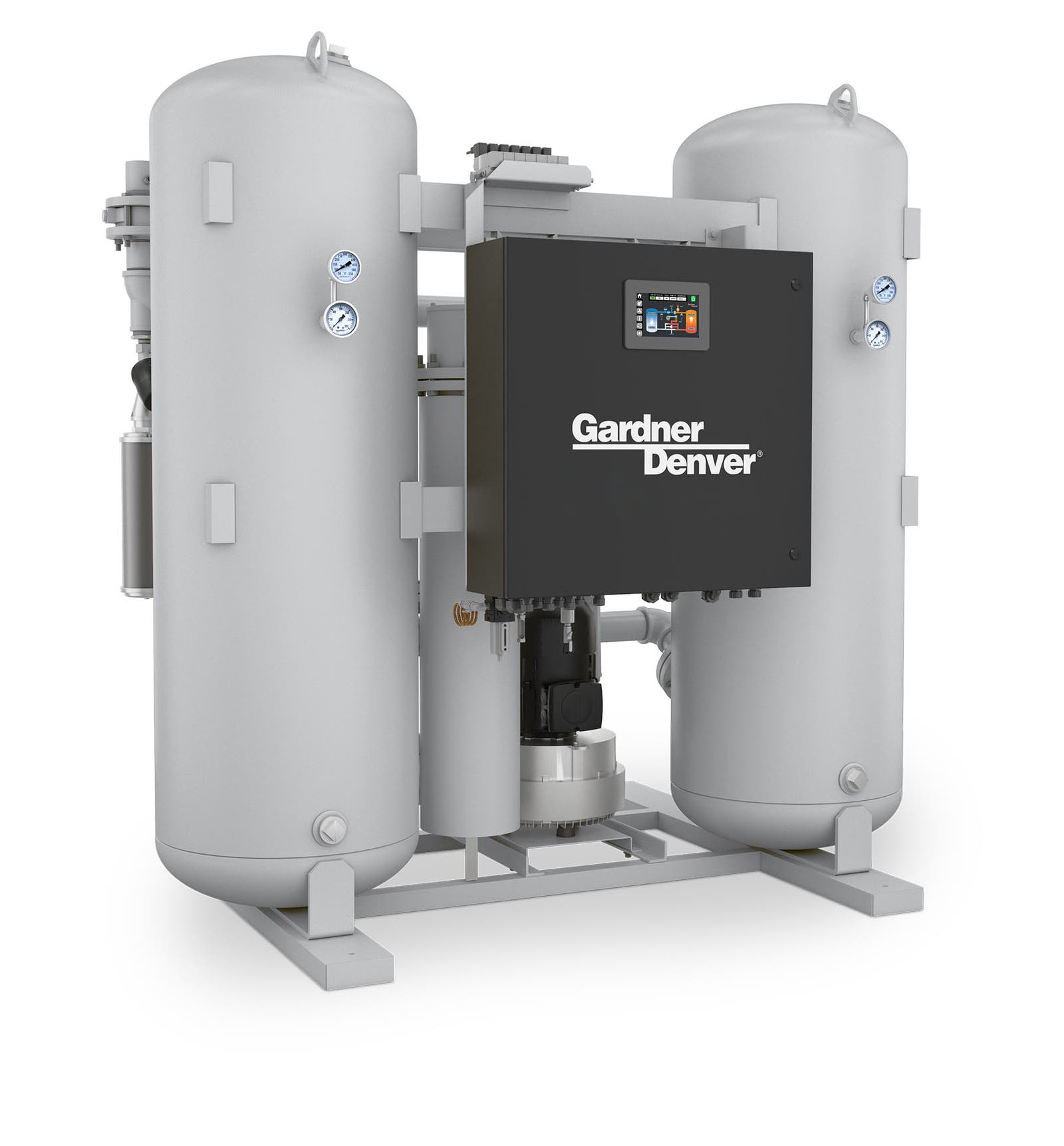
Gardner Denver Heatless Desiccant Air Dryers
Gardner Denver heatless desiccant air dryers are designed for applications requiring dry compressed air and controlled pressure dew point performance. The DGH Series offers multiple capacity options and selectable pressure dew points. Published specifications range from smaller DGH models through high-capacity systems, with the DGH5400 listed at 5,400 SCFM under the stated rating conditions.
Gardner Denver also offers the XGHL Series, a Heatless Air Dryers range with published capacities from 90 to 5,000 SCFM, standard working pressure up to 150 PSIG and customizable dew points down to -100°F. The range includes features such as digital control, tower pressure gauges, activated alumina desiccant and packaged filtration.
DGH and XGHL Series
The right model depends on the actual plant conditions. A dryer should not be selected simply because its nameplate flow appears close to compressor capacity. Inlet pressure, inlet temperature, ambient temperature, required outlet flow, pressure dew point and purge consumption all affect selection.
Gardner Denver’s DGH documentation, for example, provides correction factors for operating pressures other than its 100 psig rating condition. That is an important engineering detail because a dryer rated at a particular flow under one pressure condition cannot automatically be assumed to deliver exactly the same performance at another pressure.
CompAir Heatless Desiccant Air Dryers
CompAir heatless desiccant air dryers use twin-tower technology to maintain a continuous supply of dry compressed air. The AX-Series directs compressed air through the online desiccant tower while the offline tower is regenerated. Once the cycle changes, the regenerated tower becomes the drying tower and the previously online tower enters regeneration.
This arrangement is attractive because there is no need to stop the compressed-air supply during desiccant regeneration. The dryer controller manages the sequence of valves and tower switching, while instrumentation helps operators monitor operating conditions.
CompAir also highlights high air quality, reliability, precise sizing and energy efficiency as key characteristics of its twin-tower heatless technology. Optional features can provide additional monitoring and control for demanding industrial installations.
AX-Series Twin-Tower Technology
The CompAir AX-Series is based on a practical twin-tower arrangement. One tower performs adsorption while the second tower is regenerated using a portion of dry compressed air. The regeneration air is subsequently exhausted to atmosphere after collecting moisture from the desiccant.
This technology is particularly useful where the customer needs a dependable low-dew-point compressed-air supply without introducing regeneration heaters. However, purge consumption must be considered during system design because every cubic metre of air used for regeneration is air that is not available for the process. The best solution is therefore one that balances the required dew point with energy efficiency and operating cost.
Major Air Dryer Parts and Their Functions
Understanding air dryer parts helps plant engineers and maintenance teams diagnose problems before they become expensive failures. Although exact components vary by manufacturer and model, most twin-tower heatless dryers include similar functional elements.
| Air Dryer Part | Main Function |
|---|---|
| Desiccant vessel/tower | Contains the drying media |
| Desiccant | Adsorbs moisture from compressed air |
| Switching valves | Direct air through drying and regeneration paths |
| Solenoid/pilot valves | Control valve sequencing |
| Controller | Manages timing, switching and alarms |
| Pressure gauges/sensors | Monitor tower pressure |
| Pre-filter | Removes upstream contamination |
| After-filter | Helps remove downstream particulate contamination |
| Purge valve | Controls regeneration air |
| Moisture/dew-point indicator | Indicates drying performance |
| Muffler/exhaust silencer | Reduces regeneration exhaust noise |
| Drain system | Removes condensed liquid from filtration |
The switching valves are particularly important because the entire adsorption-regeneration sequence depends on correct airflow direction. A valve that does not fully open or close can cause pressure imbalance, poor regeneration, excessive purge consumption or wet compressed air downstream.
Filters are equally important. Liquid water and oil entering the desiccant bed can reduce performance and shorten media life. For this reason, filtration should be treated as part of the dryer system rather than as an optional afterthought.
Desiccant Materials Used in Air Dryers
The desiccant is the heart of an adsorption dryer. Common desiccant materials include activated alumina, silica gel and molecular sieve, although the appropriate material depends on the dryer design and required performance.
Activated alumina is widely used in industrial compressed-air dryers because it provides strong moisture adsorption and can be regenerated repeatedly. Gardner Denver identifies high-strength activated alumina among the features of its XGHL heatless dryer range.
Desiccant life depends heavily on operating conditions. Excessive liquid water carryover, oil contamination, high inlet temperatures, mechanical degradation and incorrect operating conditions can reduce effective performance. Replacing desiccant therefore should not be treated as the only maintenance action; the cause of premature degradation should also be investigated.
Pressure Dew Point and ISO 8573 Air Quality
When purchasing a heatless desiccant air dryer, pressure dew point is one of the most important specifications. Pressure dew point, commonly abbreviated as PDP, indicates the temperature at which water vapour in compressed air would begin to condense at the stated pressure.
A lower pressure dew point means the compressed air contains less moisture. For example, a dryer producing approximately -40°C pressure dew point provides significantly drier air than a system designed for a positive-temperature dew point. Gardner Denver’s DGH literature identifies pressure-dew-point options including -40°C and down to -73°C depending on the selected class and operating mode.
ISO 8573 provides a framework for specifying compressed-air quality. The actual requirement should be determined by the application, especially where air comes into contact with products or sensitive instrumentation. Selecting a dryer for a lower dew point than necessary can increase operating costs, particularly for heatless systems where purge air is consumed during regeneration.
How to Select the Right Heatless Air Dryers
Choosing the correct heatless air dryers starts with the application rather than the product catalogue. Before requesting a quotation, gather the compressor capacity, actual operating pressure, compressed-air temperature, ambient conditions and required pressure dew point. You should also identify whether the compressor operates continuously or intermittently and whether the air demand varies significantly during the day.
The following parameters should be considered:
- Required compressed-air flow
- Operating pressure
- Maximum inlet temperature
- Ambient temperature
- Required pressure dew point
- Air quality class
- Compressor type
- Oil-lubricated or oil-free operation
- Required filtration
- Available installation space
- Electrical supply
- Operating hours
- Expected future capacity
- Maintenance requirements
The dryer should be selected using the manufacturer’s correction factors and rated conditions rather than simply matching the compressor’s nominal capacity. Gardner Denver’s published DGH data, for example, provides pressure correction multipliers for different operating pressures.
Heatless Air Dryers Sizing Considerations
Sizing is where an experienced heatless air dryers supplier can add real value. A dryer that is too small may struggle to maintain the required dew point, while a significantly oversized dryer can increase capital cost and may not operate at its most efficient point.
Suppose a plant compressor delivers a certain nominal flow at one pressure, but the actual dryer inlet pressure is different. The available dryer capacity must be corrected for the operating pressure. In addition, inlet temperature and desired dew point can influence performance. Gardner Denver’s published DGH sizing information demonstrates this principle through pressure-based correction multipliers.
Purge consumption must also be included in the calculation. If a heatless dryer uses a portion of compressed air for regeneration, the compressor system must have enough capacity to satisfy both the process demand and the dryer requirement. This is why a proper sizing exercise should consider net usable outlet flow, not only the dryer nameplate inlet flow.
Common Applications of Heatless Air Dryers
Heatless air dryers are used across industries where moisture control is important. Typical applications include instrument air systems, pneumatic control systems, chemical plants, pharmaceutical facilities, laboratories, food processing, electronics manufacturing, paint and coating processes, and compressed-air systems exposed to low ambient temperatures.
They can be particularly valuable when compressed air is distributed through long outdoor pipe runs. A higher pressure dew point can allow moisture to condense as temperatures fall, while a sufficiently low pressure dew point helps reduce this risk. The exact requirement depends on the ambient conditions and system design.
Heatless dryers are also used where pneumatic equipment needs consistently dry air. Moisture can affect valves, actuators and instruments, while corrosion inside distribution piping can gradually compromise the system. Proper air treatment protects not only the end-use equipment but also the investment already made in the compressed-air infrastructure.
Benefits of Installing Heatless Air Dryers
The biggest benefit of a heatless desiccant air dryer is its ability to deliver very dry compressed air without an external regeneration heater. This makes the technology attractive for applications where low pressure dew point is more important than achieving the absolute minimum energy consumption.
Other benefits include relatively straightforward operation, continuous drying through twin-tower sequencing, compact packaged designs and suitability for a wide range of industrial applications. CompAir specifically highlights reliability, high air quality, precise sizing and optional energy-management functionality for its AX-Series technology.
The main trade-off is purge-air consumption. A conventional heatless dryer uses part of the compressed-air output to regenerate its desiccant. This means the customer should evaluate total operating cost rather than looking only at electrical consumption. In plants operating 24 hours a day, even a small change in purge percentage can have a meaningful impact on lifecycle cost.
Maintenance and Air Dryer Parts Replacement
Preventive maintenance is essential for keeping a heatless dryer performing correctly. Maintenance should include inspection of valves, filters, controls, pressure gauges, exhaust mufflers, tubing and desiccant condition. Filter elements should be replaced according to operating conditions and manufacturer recommendations rather than waiting until the dryer shows poor performance.
The air dryer parts most commonly requiring attention include filter elements, switching valves, solenoid or pilot valves, valve seals, mufflers, sensors, pressure gauges and desiccant. Keeping critical spare parts available can reduce downtime, particularly for continuous-process plants.
CompAir provides service, parts and support resources for its compressed-air treatment products, while Gardner Denver similarly provides service and parts support through its distribution network.
A practical maintenance strategy should therefore include a recommended spare-parts list based on the installed model, operating hours and criticality of the application.
Common Heatless Air Dryer Problems
A heatless dryer that produces wet air does not necessarily have a failed desiccant bed. Several issues can produce similar symptoms. High inlet temperature, inadequate pre-filtration, valve leakage, incorrect cycle timing, excessive airflow, insufficient regeneration or damaged desiccant can all affect performance.
Common warning signs include:
- High outlet pressure dew point
- Excessive purge-air consumption
- Abnormal tower pressure
- Continuous exhaust from a regeneration valve
- Frequent valve switching problems
- High differential pressure across filters
- Desiccant dust downstream
- Moisture indicator changing unexpectedly
- Alarm or controller faults
Troubleshooting should begin with operating conditions before replacing expensive components. Checking inlet pressure, inlet temperature, flow, filters, tower switching and valve operation can often identify the root cause faster than immediately replacing the desiccant.
Heatless Air Dryer Suppliers in India
For customers searching online for heatless air dryer suppliers, the most important question is not simply, “Who can sell me a dryer?” A better question is, “Who can correctly size, supply, commission and support the dryer for my application?”
An industrial supplier should understand compressed-air treatment, dryer sizing, filtration, pressure dew point and spare-parts requirements. This becomes particularly important when the dryer is part of a larger process plant where compressed-air reliability directly affects production.
Vartak Pumps and Project Consultants supports customers looking for industrial compressed-air equipment and desiccant heatless air dryers. The company’s product page provides information related to its heatless desiccant air dryer offering: Desiccant Heatless Air Dryers – Vartak Pumps and Project Consultants
Why Choose Vartak Pumps and Project Consultants
For an industrial customer, buying a dryer is only one part of the requirement. Correct selection, technical coordination, installation considerations, spare parts and after-sales support can be equally important. Vartak Pumps and Project Consultants focuses on helping customers identify the appropriate compressed-air solution according to their application requirements.
As a Gardner Denver and CompAir distributor, Vartak Pumps and Project Consultants can support customers evaluating established desiccant dryer technologies for industrial applications. Gardner Denver’s heatless range includes DGH and XGHL solutions, while CompAir offers twin-tower AX-Series heatless desiccant dryers.
When requesting a quotation, customers can share their compressor capacity, operating pressure, required dew point, inlet temperature and application. This allows the supplier to recommend a suitable dryer rather than simply offering a generic model.
Gardner Denver CompAir Distributor Support
Searching for Gardner Denver CompAir distributors often means the buyer needs more than a product brochure. Industrial customers may require technical selection, model identification, pricing, delivery information, installation guidance, replacement parts and service support.
Vartak Pumps and Project Consultants can assist customers evaluating Gardner Denver and CompAir compressed-air treatment solutions. Gardner Denver’s published information confirms that its DGH range covers multiple capacities and pressure-dew-point requirements, while CompAir’s AX-Series uses twin-tower heatless regeneration.
The right approach is to provide the operating data first. Once the required flow, pressure and dew point are established, the dryer can be evaluated on capacity, purge consumption, filtration, controls, maintenance and lifecycle cost instead of purchase price alone.
Final Thoughts
A heatless air dryers is an important component when an industrial compressed-air system needs consistently low moisture content and a controlled pressure dew point. Its twin-tower desiccant technology provides continuous drying by alternating between adsorption and regeneration, making it suitable for demanding applications where ordinary moisture separation is not enough. Gardner Denver and CompAir both offer established heatless desiccant dryer technologies, including Gardner Denver DGH and XGHL ranges and CompAir AX-Series twin-tower dryers. (Gardner Denver)
The most important lesson is simple: do not select a dryer based only on compressor capacity. Operating pressure, inlet temperature, required dew point, filtration, purge-air consumption and application conditions all matter. A properly sized dryer can protect downstream equipment, improve compressed-air quality and help reduce moisture-related problems throughout the plant.
For businesses searching for a heatless type air dryer manufacturer and supplier, heatless desiccant air dryer, air dryer parts, or Gardner Denver CompAir distributor, Vartak Pumps and Project Consultants can help evaluate the appropriate solution based on the actual compressed-air requirement.
FAQs About Heatless Air Dryers
1. What is a heatless desiccant air dryer?
Heatless air dryers remove water vapour by adsorption in one tower while regenerating the second tower with dry purge air, providing continuous dry compressed air.
2. What is the difference between heatless air dryers and refrigerated dryers?
Heatless air dryers use adsorption for very low dew points; refrigerated dryers use cooling and condensation for moderate dryness.
3. What are the main parts of heatless air dryers?
Major components include desiccant vessels, desiccant media, switching valves, solenoid or pilot valves, controllers, pressure gauges, filters, purge valves, moisture indicators and exhaust mufflers. Exact components vary according to the manufacturer and model.
4. How do I select the correct heatless air dryers?
Start with the required air flow, operating pressure, inlet temperature and pressure dew point. You should also consider compressor type, filtration, ambient conditions, operating hours and purge-air consumption. Manufacturer correction factors should be applied when operating conditions differ from the rated conditions.
5. Where can I get support for Gardner Denver or CompAir heatless air dryers?
Vartak Pumps and Project Consultants supports customers looking for Gardner Denver and CompAir compressed-air treatment solutions, including heatless desiccant dryer requirements. Customers can provide their compressor capacity, operating pressure, required dew point and application details for technical evaluation.